Coral shipments may be the best thing in my life. See, I laughed after typing that and went to backspace it... then realized I couldn't. I really do love getting new shipments of coral in. I'm this impulsive coral buying fiend. If corals were shoes, I'd be my sister.
Corals! (don't worry ladies, my number is at the bottom) (inserts from liveaquaria.com)
Where it all comes from!
So a lot of people are amazed about how awesome my tank looks, especially the customers at the bakery. One day, after battling my way to the front of the enamored masses staring longingly at my aquarium, I was confronted by a lovely lady. (We'll probably get married, once I find out her name.) After tearing her eyes away from the aquarium for just a brief moment, she looked up at me and asked "But where does it all come from?" I'll save you a lot of reading: the internet. The answer is that most of what's in my fish tank comes from the internet.
Here's what I got when I googled "the internet". (deviantart.net)
I only order from one website, LiveAquaria. They have a seemingly endless supply of the best fish and corals from around the globe. More importantly, the quality of their fish and coral is really unmatched. The last thing you want is some company shipping you fish that aren't exceptionally healthy.
Where all of my money ends up.
Coral Day!
Coral Day, the best day of the week, is not a routine thing. It only occurs after I've found money or after I've had just enough to drink so that I'm coherent enough to navigate the internet but not focused enough to say no. Regardless, it's a glorious day. The corals and fish ship next-day air, as fish hate airports and traveling in general.
I BET THERE'S CORAL IN THERE!
I guess I could have put something in the picture for scale, but I think you get the idea. This box contains three small bags with polyps and a big bag with a bubble coral inside.
Barely contained excitement.
I usually just use a razor blade to open up the cardboard box. On the inside is a styrofoam box. If you've ever used one of those small styrofoam ice chests, it's essentially the same thing.
The cozy coral chest.
Since it's kind of a pain to get the ice chest out of the cardboard, generally I cut down along the corners of the box and slide the ice chest out.
Surgically precise box extraction.
The lid is just taped down with some clear shipping tape, so all you have to do is rip it off. Depending on how excited you are for Coral Day (super excited) generally dictates how you handle this step. At the top of the box are these little water activated packets that control the temperature inside the ice chest.
Heat packets (like the ones in MREs).
Like I said, these are water-activated heating packets that keep the ice chest at around 75- 80 degrees Fahrenheit. Styrofoam is a great insulator, so whatever temperature you have inside the ice chest, it will stay that temperature. It doesn't necessarily have to be used for cold things. Styrofoam just prevents the temperature outside the box from affecting the temperature inside the box.
The peak of comfort.
The corals are placed inside of 4 bags each. These bags are filled with pure oxygen and then clamped shut with metal clips. Then they stuff the bags inside of the ice chest and fill it with packing peanuts (look up).
Do not place in vacuum shoot.
The corals are shipped in 4 bags each. In the picture above, you can see the metal clip holding the bag shut. You'll also notice there are two black shields, one at the top and one at the bottom of each bag. These help block out light. It's less stressful to the corals and fish if the light intensity isn't changing sporadically. To remedy this, they try and keep all light out when they package them for shipment.
"LOL HE LEFT THEM IN THE BAGS!!!"
The next step only really has an impact on fish and invertebrates, but for the sake of this post I decided to show you anyway. I place the bags in my sump (the tank located underneath the main aquarium, used to house the filtration system) for about 15 minutes to let the corals and fish adjust to the temperature of the aquarium.
The first of many layers.
After about 15 minutes I cut open the bags to start acclimating the corals to the same salinity and nutrient levels that my aquarium has. The picture above is after cutting off the first metal clip top-knot thing you saw earlier.
So close.
The final two bags are upside-down and sealed again with a metal clip. The idea with the excessive bagging is to prevent the corals from puncturing the bags and leaking all over the ice chest. This would not only make a mess, but also it would leave the corals without water. If you've been following along so far then you know that would be a bad thing.
It's like a sleeping mask! For fish!
This is a picture of what the black covers look like up close. So now that you've seen the layering of the bags, I can try and explain in a little better detail how they're wrapped. So the first bag containing the coral has a black cover placed over the bottom of it, then it's placed inside of another bag. The first bag is then filled with pure oxygen and the two bags are sealed with a metal clip. Then this mated bag contraption is flipped upside down and inserted into another bag. This third bag then has a black cover placed over the bottom of it as well. Once that's done, the entire thing is put into yet another bag (bringing the bag total to 4) and sealed yet again with a metal clip.
The only thing holding back hot steamy bag romance.
After I cut the metal clips off and break up the bag orgy, I start adding water from my aquarium to the bags. This allows the corals to get used to the specific water qualities that my aquarium water has.
Never accept a drink from me.
I'll add about one cup of water to the bags every 30 minutes or so depending on the hardiness of whatever it is I'm trying to acclimate. Corals don't generally require an acclimation like this, you could just put them straight into the tank. Regardless, it never hurts to slowly acclimate them to your aquarium water.
Side view of the coral frag on a plug.
The picture up above is what the corals are attached to inside of the bag. The plug that the coral is attached to is inserted into a piece of styrofoam and placed upside down inside the bag. This ensures that regardless of how the shipping container is handled (it's always poorly), the coral will remain covered in water since styrofoam floats.
Top-down view of the coral frag.
These are Zoanthids, a type of polyp coral. This coral looks like little purplish balls when it's closed. They're shipped attached to an aragonite plug. The reason for this is so that you can place the plug wherever you'd like inside the aquarium. This would be considered a "frag" or fragment of coral from a larger piece. Since a frag is smaller and isn't originally attached to anything, they place them on these aragonite plugs. If they didn't do this, the corals would just float around aimlessly until they got stuck under a rock or sucked into a filter.
Partially opened Zoanthid polyps and Ringo the red sea star.
Once the corals are acclimated for a little while inside the aquarium, they'll start to open up. These Zoanthid polyps started opening up after a few hours of being inside the aquarium. The bubble coral I got in this shipment probably won't open up fully for at least three days or so.
New neon green bubble coral (not fully open).
If you look closely, you can see the calcium carbonate skeleton of the coral just under some of the bubbles. This bubble coral is actually resting on a dead pineapple coral (morbid I know, but he has no idea). The stark white coral with little circles all over it is a pineapple brain coral that didn't make it. It's unfortunate, but it's something you get used to when you're in the hobby. For reference, here's the other bubble coral in the tank. This one is all white and fully open.
Love at first sight.
As you can see, or I guess as you can't see, the skeleton of this coral is completely hidden by the meaty part of the coral.
Dat New New
I know it's been a while since I've posted a picture of my aquarium, but if you must know I'm absolutely terrible at taking panoramic shots on my camera. I'm working on it, I promise, but in the meantime here's a picture that I took from far away.
I wish I owned a real camera.
A lot has changed, so hopefully you can make out some new pieces. I promise I'll have a better picture of the entire tank next time. Additionally, I'm also working on getting glamor shots of all the individual corals and fish. As always, thanks for reading! I hope I've left you feeling a little wiser, and if nothing else at least entertained. And If you have any questions, please don't hesitate to ask.
I'll start off by apologizing for taking so long to produce this. I know you've all been waiting anxiously on the edge of your seats for the next installment of Fishy Fishy. Just kidding. (Hi mom!) Fortunately for you, if you're reading this it means I've written a new piece! So let's get started.
Clownanemonedamselfish
One word: clownfish. Clownfish! The lovable white striped orange-scaled bags of fun! Everyone loves Nemo. (I'm looking at you, satan.) Clownfish go by several names: anemonefish, damselfish, Nemo, terror-of-the-deep-that-will-tear-pieces-of-your-finger-off-for-putting-it-in-the-aquarium (source needed), but we all know what a "clownfish" looks like when someone shrieks their name.
Kids, stay in school.
Nemo! The entire world knows what clownfish are thanks to this lovable little degenerate. I can't say I'm angry, because honestly I wouldn't know what they were either if it weren't for him, but there's so much more to it! The types of clownfish available in the aquarium trade have as much character and personality as you could ask for in a pet fish.
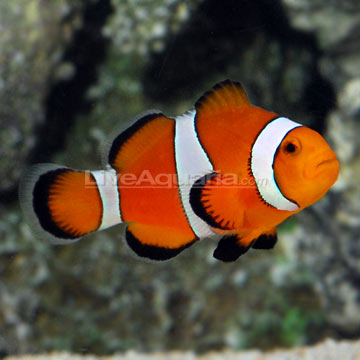
Amphiprion ocellaris, also known as the False Percula Clownfish, and Nemo's stunt double.
Why Clownfish are Awesome
So, this section should be rather extensive, but this is one of those crossroads where you have to weigh what's awesome and what people might actually read. I've chosen the latter. The neat thing about clownfish that separates them from the rest of the fish peasants is that they are nearly immune to the stings of anemones.
Sup?
See, if you remember the death tentacle harpoons of... death from my last post, you might find yourself wondering "but the nematocysts! THE NEMATOCYSTS!" To which I would say, "dude..." You see, clownfish are immune to the sting of their anemone. This allows them to clumsily swim about through the tentacles of death, safe from harm. This is great for them because they're not very good swimmers, and they're fat. In short, clownfish are the perfect snack for reef predators. Clownfish cannot survive in the wild without their protective tentacle homes.
"We love you!" - every clownfish ever (saltaquarium.about.com)
Anemones aren't required to keep clownfish in the home aquarium, but they do improve the overall health and happiness of your clownfish. The anemone also benefits from the clownfish, which pay rent by doing chores. This includes, but is not limited to, cleaning the tentacles of the anemone, cleaning the anemone's oral disc, scaring away predators of the anemone, increasing the oxygen levels around the anemone via swimming about, and providing a friend to complain to about how Nemo leaves the seat up.
From Marlin to Marlene
Another neat thing about clownfish is that they go through what is delightfully referred to as protandrous hermaphroditism. That is an extensively lengthy way to say that the males turn into females when there is no dominant female present. Clownfish are born without a determined gender. Then, if no male is present, the largest undetermined juvenile will morph to become a male, and then continue to morph into a female if there is no dominant female present. Once this happens, another juvenile will morph into a male and the two will become a mated pair. The rest of the clownfish associated with that anemone will remain undetermined juveniles for the rest of their lives, or until either the male or female dies. In this case, the process repeats itself. I think you know where this is going...
Marlene, Nemo's eventual wife-father.
I really hope I'm not ruining this movie for you, but I can't help but be truthful. Sensing that there was no dominant female in the group, Marlin, Nemo's dad, would have changed into the dominant female. In turn, Nemo would morph into the male, and they would live hap... well they would live ever after. But this is awesome! Many fish are born without a gender, and then morph to fit whatever is needed. Clownfish are special in that they become males first and then females, as opposed to becoming females first and then males.
Mature pair with an undetermined juvenile (photos.nwf.org).
Size Matters
When trying to form a mated pair of clownfish for your aquarium, it's important to know what you should be looking for. Females are generally larger than the males. What you're looking for when you're trying to pair two individuals is a big size difference. You want the largest clownfish possible to be isolated with the smallest clownfish possible. This increases your chance of getting a female and either a small male or a genderless juvenile.
Romeo and Juliette (again) with their anemone, Shakespeare.
It might be a little difficult to tell, but Juliette (right) is probably three to four times as big as Romeo (left). This is a good thing! When I first got Juliette, she was already pretty big and paired with a decently sized male. Unfortunately the male didn't make it and I had to replace him. So, I did what any smart aquarist would. I found her the smallest tomato clown I could and quite literally tossed him to the fishes. He's grown maybe an inch in the last five years. Since clownfish hit a terminal size depending on their gender, a good way to tell how old one might be is to look at the depth of their color. The longer a fish lives in an aquarium, the deeper its colors (generally).
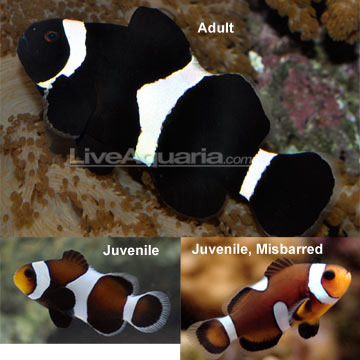
The Black and White Ocellaris clownfish darkens with color as it matures.
The larger the size disparity, the less likely the male (or genderless juvenile) will resist the dominant female. The male will do a sort of subservient dance where he'll sort of shake his entire body like he's being electrocuted. It's the same little dance clownfish will do prior to spawning. Here's a video on youtube that shows it pretty well. The magic starts around 0:24 if you don't want to sit through the musical delight.
Common Aquarium Clowns
I've been resisting the entire time, and I'm not entirely sure why, but it's common to refer to clowfish as just "clowns." I know I'm not going to throw anybody for a loop and have them picturing a curly haired, red-nosed demon-spawn with a permanent smile when I say clown, but I like to make sure we're all still on the same page here. Now I'd like to take a minute and show you some pictures of some clowns that are fairly common in the aquarium trade.
True Percula Clownfish (Amphiprion percula)
"I'm like Nemo, but better!"
The Percula or True Percula Clownfish looks very similar to the Ocellaris Clownfish from earlier. The most notable difference is that it has a little bit more black around the midsection. It's also not as hardy as the Ocellaris Clownfish and requires a little better water parameters and hardier meals. These generally stay small, about 3" max, and do well in almost all marine aquariums.
Tomato Clownfish (Amphiprion frenatus)
"I will eat your face." - Juliette
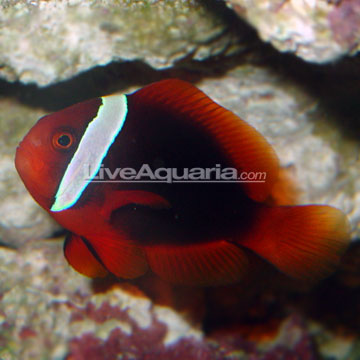
The Tomato Clownfish or Red Clownfish has a red body that gets darker with age. It only has one stripe, located behind the eye. The stripe tends to glow if the clown is very healthy. Tomato Clownfish get a bit bigger than the Ocellaris and Percula clowns, growing up to about 5". They're also incredibly aggressive. I'll post a video in my next update about how I feed my aquatic friends, and in it you'll see just how aggressive Juliette is. When I put my hand into the tank, I'm expecting her to get at least a couple bites on me before I can finish what I need to get done. Oh, and she has teeth; tiny, sharp, vicious little teeth, and they hurt.
"I hope you don't think Juliette is mean." - Ms. Approachable
The Yellowstripe Maroon Clownfish is very similar to the common Maroon Clownfish except that its stripes are (wait for it...) yellow! The clown in this picture isn't particularly dark, but I've seen some maroon clowns get very, very dark, and their stripes become golden. They're incredibly gorgeous fish. However, as the caption suggests, maroon clowns are notorious for their aggression. They grow up to about 6" in the home aquarium, and more vicious with each inch. I wouldn't put these in a tank with more docile fish, and definitely the bigger the tank the better. Large tanks reduce aggression because it provides all the inhabitants with more room to stretch their fins. This of course has a much smaller impact if you overstock your tank.
Cinnamon Clownfish (Amphiprion melanopus)
Juliette's cousin.
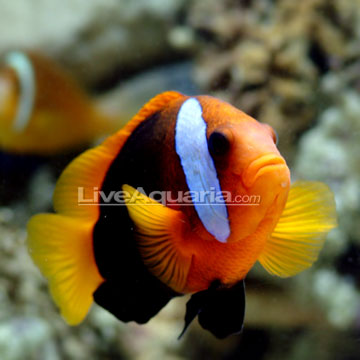
The Cinnamon Clownfishis similar to the Tomato Clownfish in all regards, except for the slight difference in coloration. Instead of being red, the cinnamon clown has a dark orange body with yellow fins. Like the tomato, it also only has one band, located just behind its eye. They grow to be about 5" in the home aquarium. Generally the larger the clown the more aggressive. However, an anemone can have the added benefit of controlling their aggression. While the addition of an anemone might make the clownfish more aggressive, it will also reduce the range of its aggression to wherever the anemone is. Clownfish don't like to leave their anemone. With that in mind, if you can place the anemone to one side of the aquarium, you'll reduce the range of your beautiful, though overly aggressive, clownfish.
Clarkii Clownfish (Amphiprion clarkii)
Big beautiful clownfish.
I love Clarkii clowns. When I first found out that clownfish came in colors other than orange, I immediately tried to find the most exotic one. For me, it was the Clarkii Clownfish. They have the size that the maroon and tomato clowns have, growing up to 6" in the home aquarium, but their heads are a little more rounded in the front. This makes them seem massive in comparison. They also have a deep black body contrasted with stripes so white they almost glow blue. To finish off this beautiful clown, it has a bright yellow belly.Pictures honestly don't do this clown justice.
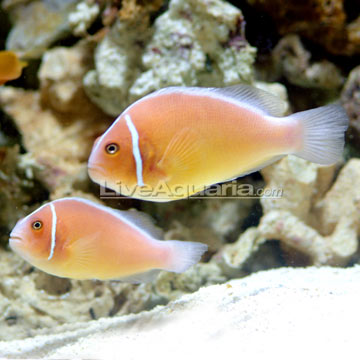
Pink Skunk Clownfish (Amphiprion perideraion)
Nemo's naked cousins.
If hippie fish existed, these would be them. The Pink Skunk Clownfish grow to about 4", but they're not aggressive. It's perfectly acceptable to have several juvenile skunks live in harmony with a mature pair in an anemone. Most clowns, especially the larger ones, would not allow this unless it was in a very big system and all of the clowns were introduced to the aquarium at the same time. Skunk clowns are a light creamy orange color with one white stripe behind their eyes and one white stripe that runs along the entire length of their back.
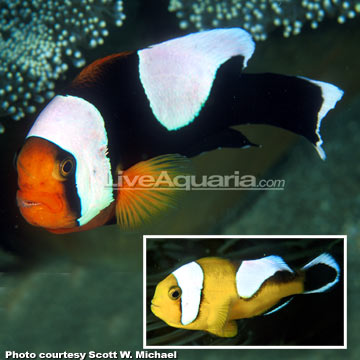
Saddleback Clownfish (Amphiprion polymnus)
"Yeehaw! No seriously don't ride me."
The Saddleback Clownfish is unique in its appearance. Its middle bar stops about halfway down its body giving it the appearance of having a saddle on its back. They are also easily recognizable from the way they swim. Saddleback clowns kind of bob their entire bodies up and down while they tread water. It's like they're on a treadmill that has hills. Saddleback clowns can also be kept in small groups, like the skunk clowns. They're generally peaceful towards their tankmates. Saddleback clowns grow to about 4". They come in brown, tan, black, and yellow. As with most clowns, their bodies darken with age, becoming close to a dark black as they mature.
But I have all this money and clownfish are too affordable!
"Said no one ever." I know, I know. If you didn't know, saltwater aquariums are very, very expensive. A "cheap" fish costs between $20 and $30, and corals generally start at $30 or so for a small fragment of a few polyps. Most of the clowns on this list range anywhere from $10 (the cinnamon clown) up to about $45 (the black ocellaris clown). All things considered, that's cheap for saltwater fish.
These are actually made entirely of gold.
The reason clownfish are relatively cheap is because they're one of the few fish that are aggressively bred in captivity. Due to their relatively simple lifecycle and spawning prowess, clownfish are the ideal candidates for aquaculture (the practice of breeding and growing aquatic life in aquariums). Due to the advances in aquaculture technology, it is now very easy for companies to breed clownfish in large numbers. Occasionally, odd genetic morphs appear in the offspring. These individuals are then selected out and bred, creating clownfish with very unique morph patterns. This is where the money comes in. While it's not uncommon to pay $80 to $120 for a mature mated pair of clowns, these "designer" clowns fetch anywhere from $150 to $800 per pair. The sky really is the limit when it comes to what people will pay for exclusive, uniquely morphed patterns.
USA Tank Bred "Gladiator Clownfish" (Amphiprion ocellaris) $150
ORA "Premium Snowflake Ocellaris Clownfish" (Amphiprion ocellaris) $380
SA "Fancy Ocellaris Clownfish" (Amphiprion percula) $250
ORA "Ultra Spotcinctus Clownfish" (Amphiprion bicinctus) $250
ORA "Tank Bred McCulloch's Clownfish" (Amphiprion mccullochi) $800
These are just some of the exotic clownfish available. Personally, I don't think I could put up that much for a pair of clowns, though I'm sure my family would say otherwise. If I had my choice, I'd get a pair of black snowflake ocellaris clowns. They run about $450 for a pair. Here's the best picture I could find of them:
Sea & reef Aquaculture "Phantom Clownfish"
Some people might say I have a problem. Well, yes. Yes I have a problem.
As always, if you have any questions about anything aquarium related, don't hesitate to ask! Thanks for reading.
I love anemones. I'm not afraid to say it, it's true, and more importantly I know how to say it! The pronunciation is "uh-nem-uh-nee," for all those interested. I know there's a million different ways people try to say it, but if you want to impress your lady and guy friends (you do), then you're going to want to pronounce it correctly. And for good reason, because anemones are awesome. They're these slimy, gooey, water filled bags of joy with harpoon tipped appendages that capture prey with a vicious vendetta. They're the living offspring of spider webs and Venus flytraps if spider webs could eat your face while you walked into them and Venus flytraps were equipped with motion-sensing harpoons. They're the insatiable stomachs of the oceans, and you need to love them. Unfortunately, I find that many people don't actually know what an anemone is, or how to even identify them. That changes today, minions. Today I want to talk about anemones and their noodley appendages.
Heteractis magnificawith an ocellaris clownfish (www.boundless.com).
Look, I've seen Finding Nemo, ok?
An older woman was in the shop the other day, and staring at the aquarium like I normally do, she assumed I had some idea about what was going on (poor lady). So, she walked up to the tank, pointed at what my cousin and his girlfriend refer to as a "sea pancake" and said, "Now I know the rest of this stuff is anemones, but what is THAT?" That's when I realized that unless you're an aquarist or an ocean fanclub member, you probably don't know what anemones actually look like. Ok, maybe that's not fair. You might know they have tentacles and that Nemo lives in one, but aside from that there's not much discrimination between wavy things underwater.
Tentacles? Check! Is it stuck to a rock? Check! ANEMONE!
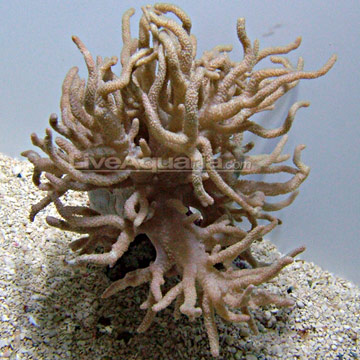
However, there's a lot more to anemones than flimsy appendages. For instance, the picture above is actually a spaghetti finger leather, and no you can't eat it. You're not entirely off the mark by thinking it's an anemone, though. Actually, clownfish (sometimes called anemonefish due to their symbiotic relationship with anemones) will treat corals like this one as if it were an actual anemone. They'll swim all through it, rubbing their little bodies seductively all over them, and challenge any fish foolish enough to swim by.
Clarkii clownfish doing her thing in a spaghetti finger leather
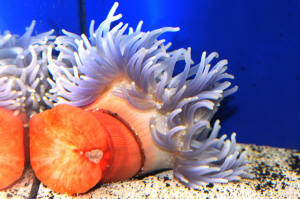
I promise not to give you a lesson in phylogenetics, but there are few distinct things that separate anemones from corals. For one, anemones can move around on their own. Their "foot," also called a pedal disc, is what they use to move around the aquarium. It's very similar in function to a snail's foot. If you can envision an anemone as an upside down jellyfish with a snail's foot where the "head" of the jellyfish would be, you've pretty much summed up what anemones are. They also have a long, fleshy stalk or base which acts as its torso, connecting the oral disc to the pedal disc. This stalk is soft to the touch, and can extend or contract depending.
The red circle towards the left is the anemone's foot.
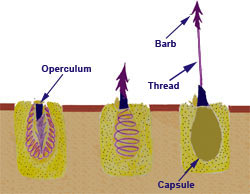
The tentacles of anemones and jellyfish are equipped with motion-sensing harpoons called nematocysts. The basic design of these microscopic deathsicles is that there are small chambers located all over each tentacle. Within these chambers is a harpoon or barb. The barb sits inside of the chamber attached to a very thin thread that stays coiled around it. On the outside of the chamber is a small hair filament that acts as a trigger. If the hair detects any contact, there is an immediate stimulus-response mechanism that fires the barb out of the chamber and impales whatever made contact with the hair. The biological beauty of this mechanism is that there is no processing done by the "brain" of the anemone. It's exactly what you'd call a "knee-jerk" reaction. It's a lightning fast impalement aimed at disabling its prey so that it can slowly move it towards its mouth and enjoy dinner.
Nematocyst up close (www.mesa.edu.au).
Anemones also only have one mouth, located in the middle of all its tentacles. Since an anemone is a single individual, it only has one mouth. Corals are generally a colony of individuals that live and grow together. This means that each individual of the colony, also called a polyp, has its own mouth that it uses to ingest microplankton. If you're staring longingly into a mass of tentacles (this is not a euphemism) and notice that it has more than one mouth (also not a euphemism), or that you can't even see a mouth, then chances are it's not an anemone.
Anemone showing off its oral disc and mouth, located in the center.
If you look at the picture back up there showing the anemone's foot, you'll notice that the anemone doesn't appear to have an anus. Unfortunately for it, its mouth and anus are the same orifice. After the anemone has moved its prey into its mouth by way of its tentacles, it ingests the prey, digests it, then gracefully excretes the waste back through its mouth. Delightful creatures! I like to think of them as ocean stomachs, because all they really do is eat fish and get huge. They don't go on hundred mile migrations, they don't pounce on unsuspecting prey in heroic triumph, hell, sometimes they don't even kill their own prey. All they do is find a nice spot, plop down, and start waving their groovy tentacles hoping for a meal.
It's like a jack-in-the-box, except in reverse... and the crab dies at the end.
Psychedelic Shapes and Groovy Colors
Another important thing to note is that not all anemones look alike. There are anemones of all different colors, some of which are a combination of multiple colors, and their tentacles also vary between species. Their tentacles can be long, short, curly, or bulbous.
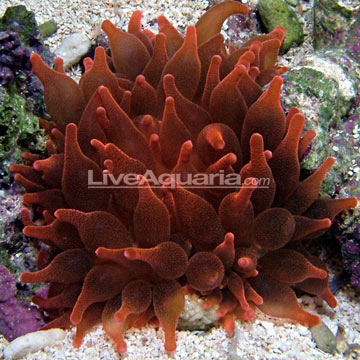
Rose bubble tip anemone (long tentacles that contract under intense lighting at the tips to form bulbs).
Ritteri or magnificent anemone (long, waving tentacles).
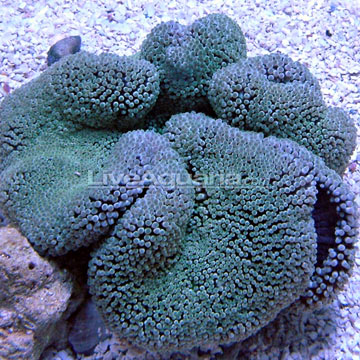
Carpet anemone (short, sticky tentacles).
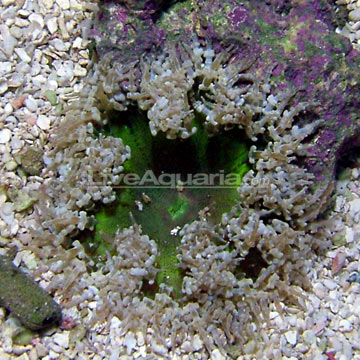
Corkscrew or long tentacle anemone (long, curled tentacles).
The color of an anemone varies depending upon a few things. The color actually comes from the symbiotic algae that lives within the anemone. This algae is called zooxanthellae algae, and it is a photosynthetic organism that turns light into energy. Through photosynthesis, the algae creates food for the anemone, and in turn is given a place to live (within the anemone). Sometimes anemones will lose their color and turn translucent white. This is called bleaching and is generally due to the zooxanthellae algae leaving its host anemone. Unfortunately, this usually leads to the death of the anemone. Zooxanthellae are also responsible for the colors of all photosynthetic corals. Bleaching can happen to corals as well. Unfortunately, coral bleaching has become an increasing concern for biologists. Many reefs around the world have experienced intense bleaching events which have led to massive die-offs of the reefs.
Coral bleaching of a brain coral.
Coral or Anemone?
Now I'd like to take a minute and show you some corals and anemones and let you try and identify which ones are corals and which ones are our lovable ocean stomachs. Try and remember the important things to look for. I know it's difficult from pictures because sometimes you can't see the telltale signs of what makes it an anemone or not, but I'm not grading you so calm the hell down.
(a)
(b)
(c)
(d)
(e)
(f)
(g)
Answers!
(a) Yes! This is known as a rock flower anemone. You can see its oral disc and mouth, along with its curled tentacles that border its oral disc. You can't make out the stalk because the picture was taken from a bird's-eye view.
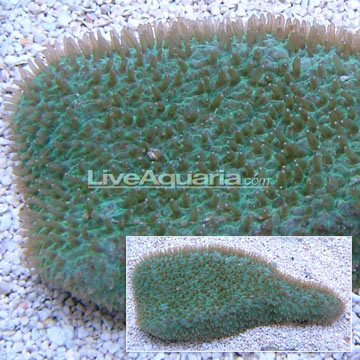
(b) Nope! This is a coral known as a slipper or tongue coral. It's actually comprised of a calcium carbonate (what bones are made out of) skeleton surrounded with a fleshy skin. It has small tentacles, similar to the carpet anemone from earlier, however it lacks an easily identifiable mouth and it also doesn't have a round shaped oral disc.
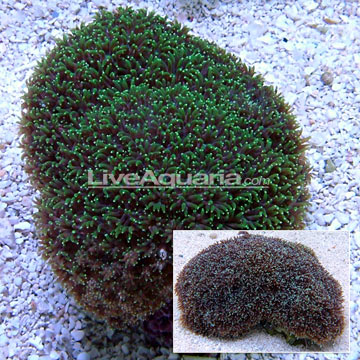
(c) Nope! This is a coral known as galaxy or tooth coral. It has a massive amount of thin, long tentacles that it extends out to trap microplankton and to sting nearby corals. However, if you look closely you'll see that the tentacles are actually in small groups all over the face of the coral. This is because each little bundle of tentacles is actually a single polyp with its own mouth.
(d) Yes! I believe this is a white-spotted condy anemone. The stalk and tentacles are easily noticeable, and if you look closely you can make out a little bit of the oral disc. The oral disc also has the stereotypical round shape to it.
(e) Yes! This is a wild specimen of Heteractis magnifica, or ritteri anemone. This species is one of the largest known anemones. This particular one has a massive purplish stalk and beautiful lime green tentacles. The clownfish residing within it are known as skunk clownfish. They're generally pretty passive towards each other and other clownfish. It's not uncommon to have a mature pair and several juveniles sharing the same anemone.
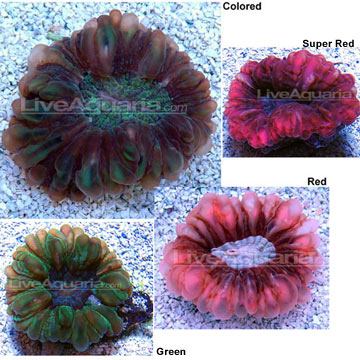
(f) Nope! These are corals known as button corals. They have a central mouth, but there shapes are a little more oblong than we'd expect for an anemone. Also, they don't have any discernible tentacles. These corals also have calcium carbonate skeletons surrounded by a fleshy skin, just like the slipper coral.
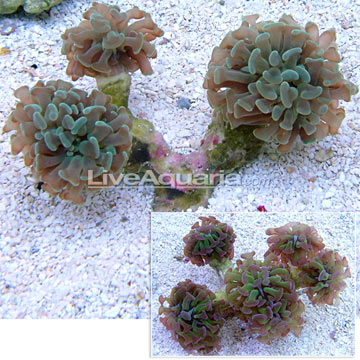
(g) Negative. These are branching hammer corals. You can see that the heads (polyps) of the corals all attach to each other via their own long, calcium carbonate skeleton stalk. If one of these heads died, it would be possible for the rest of the polyps to survive. These corals are also generally easier to propagate as well. (Coral propagation can be done a number of ways. Propagating a branching coral such as this one is done by clipping off one of the coral branches at its base with a pair of bone cutters. The coral is then relocated and will eventually grow bigger and make new branches.)
The Sea Pancake
As I said earlier, I love anemones. They've always had a squishy, tender place in my heart. Unfortunately, anemones require a very healthy aquarium with very low nutrient levels. It's important to note here that "nutrients" in this sense refers to phosphates and nitrates, which are byproducts of fish waste (no one likes swimming around in their own... well, you know). And, if you remember, I wasn't exactly Mr. Diligent when it came to aquarium maintenance back in the day. Suffice it to say I'd killed my fair share of squishy sea stomachs. However, I recently acquired an awesome green carpet anemone (my favorite species) that my clownfish absolutely adore, and it's doing swimmingly! Without further ado, I present to you the sea pancake, the true anemone of the aquarium, Shakespeare.
Romeo and Juliet (tomato clownfish) with their carpet anemone, Shakespeare.
There's a lot more to be said about these amazing animals, but it's already a miracle if you made it this far in the post. In the future I'll try and do an entry more focused on anemones for aquariums rather than anemones in general if anyone would be interested in that. I just wanted y'all to have a little better understanding of what an anemone is and why they mesmerize me so much. There's a lot to be said about their symbiotic relationship with clownfish, as well as which anemones certain species of clownfish and damselfish prefer. But again, that's for another day. I hope you enjoyed learning about anemones! As always, if you have any questions, please don't hesitate to ask.